Your home, kept comfortable.
This HVAC contractor in Irvine handles cooling and heating from the first diagnostic through installation, tune-ups, and emergency repair. If you searched for an HVAC contractor near me because the AC quit during a Santa Ana afternoon or a furnace short-cycled on a cold January night, the crew works your address the same day where the schedule allows. Every quote is a ballpark first; the exact figure is confirmed on-site after a tech sees the equipment.
Tell us about your hvac contractor job, we'll get you a fast quote.
A firm, all-in price confirmed before we start, no surprises.
On time, done to standard, and tidy when we leave.
Reach a real Irvine hvac contractor technician to describe the problem, no call-center runaround.
We look at the actual system and explain what is going on before any work.
You get the price for the fix up front and decide before we proceed.
Serving Irvine and the surrounding area, confirm coverage by phone.
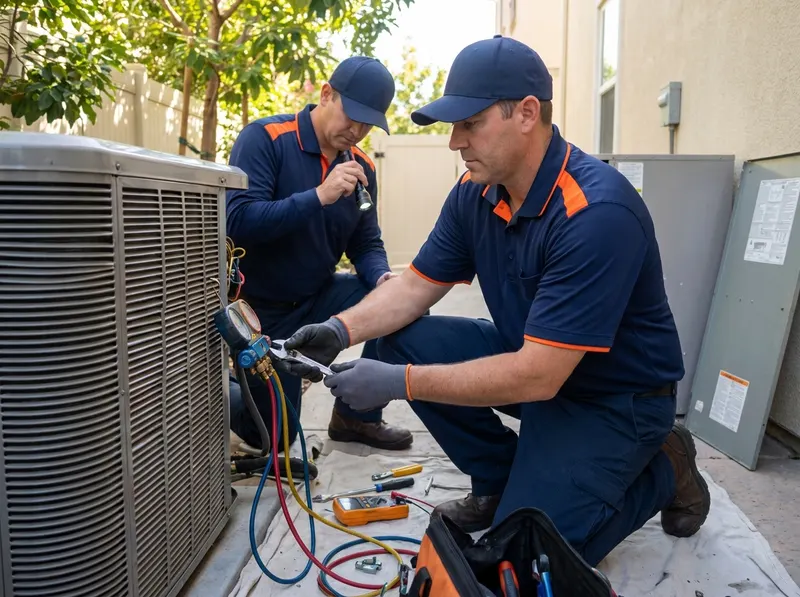
Choose AC repair over replacement when the system is under roughly 10-12 years old, the failure is a single part, and the rest of the unit still holds refrigerant and cools evenly. A blown capacitor, a failed contactor, a clogged condensate line, a tripped float switch, or a low charge from a small leak are all straightforward fixes that cost far less than a new system. When a compressor fails on an aging unit, or the same repair keeps recurring, replacement often makes more financial sense, and the technician will lay out both numbers so the choice is yours. The trade-off is simple: a repair gets cooling back cheaply today, while a replacement resets the clock on efficiency and reliability.
Irvine's climate puts specific stress on cooling systems. Homes in Woodbridge and University Park have condensers that have run through many long inland summers, and older capacitors and contactors are the parts that give out first under repeated heat cycling. In Turtle Rock and Quail Hill, units set against the hillsides collect dust and dry-brush debris off the canyon edges near Bommer Canyon, which chokes airflow across the condenser coil and forces the compressor to work harder. Newer construction in Portola Springs, Cypress Village, and the Great Park Neighborhoods tends to have tighter, higher-efficiency systems where the common failures are thermostat wiring, control boards, and drainage rather than worn mechanical parts.
Drainage problems are one of the most frequent repair calls across Northwood, Northpark, and Oak Creek during humid stretches. A blocked condensate line backs up water into the pan, and a safety float switch shuts the system down to prevent overflow, which reads to homeowners as a total failure when the actual fix is a line clearing. Refrigerant issues are the other common category: if a system takes longer to cool the house after an afternoon near the Irvine Spectrum Center or errands out toward Tanaka Farms, a small leak has usually lowered the charge and the coil may be icing over. The technician finds and addresses the leak rather than simply topping off refrigerant, because a recharge without a repair fails again within a season.
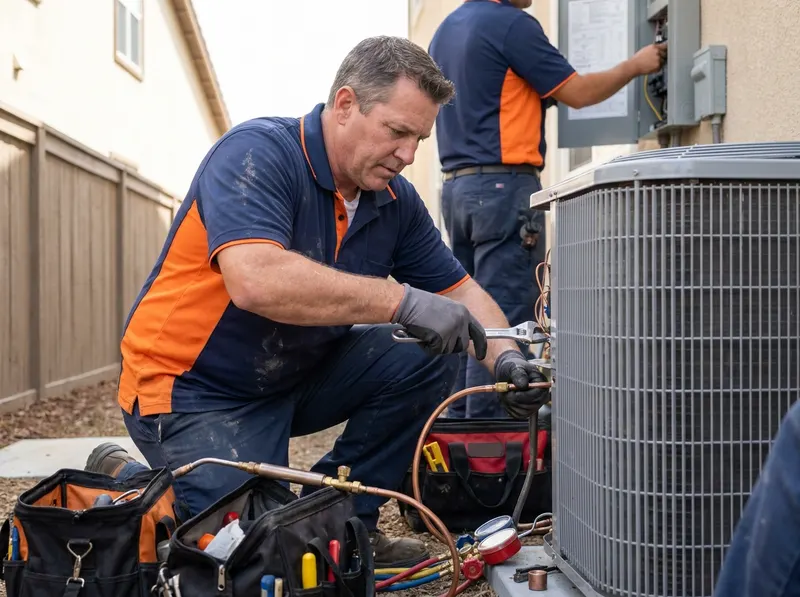
Replacement makes sense when a condenser is more than 12 to 15 years old, uses discontinued R-22 refrigerant, or needs a repair that costs a large share of a new unit's price. A new install is the right call for a room addition, an ADU in a Great Park Neighborhoods lot, or a home that never had central cooling. The trade-off is upfront cost versus years of lower repair bills and better efficiency, and a right-sized system almost always wins over patching a unit that short-cycles every summer.
Sizing is where most Irvine installs succeed or fail. An oversized AC cools the air fast but shuts off before it pulls humidity, leaving Turtle Rock and Bommer Canyon-adjacent homes clammy; an undersized one runs nonstop during the inland afternoon heat that settles over Portola Springs and Cypress Village. We run a load calculation on ductwork, window exposure, and insulation rather than guessing by square footage, which matters for the west-facing two-stories common in Quail Hill and the tile-roof homes near University Park.
Home age shapes the job across Irvine. Woodbridge and University Park homes from the 1970s and 80s often need duct sealing or an upgraded electrical circuit alongside the new unit, while newer builds in Northpark, Oak Creek, and the Great Park Neighborhoods usually have tighter envelopes that let a smaller, high-efficiency system carry the load. Northwood's mature-tree lots can shade a condenser and help it run cooler, which factors into placement.
Every central AC replacement in Irvine coordinates with City of Irvine permitting and current Title 24 energy requirements, and we verify refrigerant charge and airflow before we leave so the system performs the way its rating promises. The old equipment is hauled off and disposed of as part of the job.
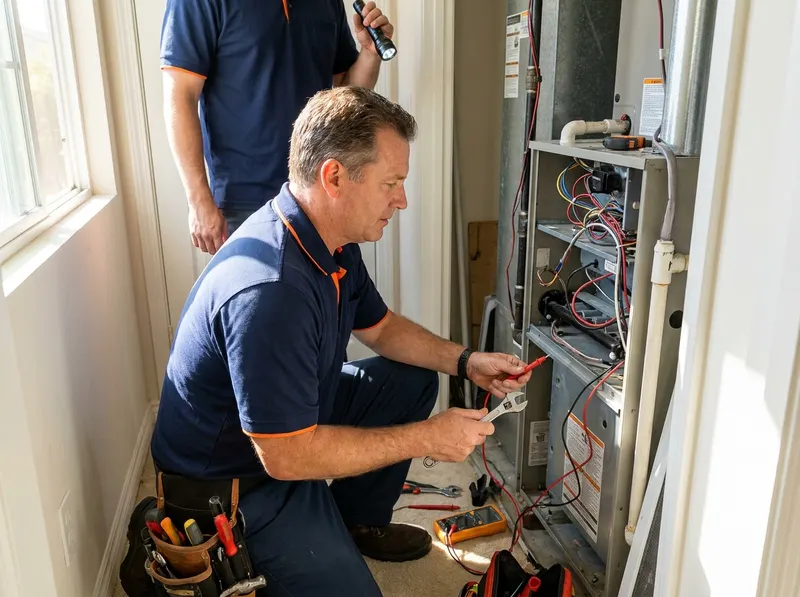
Furnace repair makes sense when the unit is under roughly 12 to 15 years old and the failure is a single, isolated part. A cracked ignitor, a dirty flame sensor, or a seized blower motor are textbook repair-not-replace situations, the fix restores full heat for a fraction of a new system. Repair stops being the right call when a heat exchanger cracks, when the same furnace has needed multiple part swaps in one season, or when the unit is old enough that the next failure is likely within a year. In those cases the honest move is to price a replacement instead of pouring money into a failing cabinet. We tell you which side of that line your furnace is on before you spend anything past the diagnostic.
Irvine's climate shapes what actually breaks. Furnaces here idle from spring through fall, then get asked to run hard during the first cold week. Flame sensors oxidize and blower capacitors weaken during that long off-season, so the classic Irvine no-heat call is a furnace that ran fine last winter and now clicks but won't light. Homes in Turtle Rock and Quail Hill that back up to Bommer Canyon pull in fine dust that clogs sensors and coats limit switches faster than average, which shows up as short-cycling. Newer Great Park Neighborhoods, Portola Springs, and Cypress Village builds often run high-efficiency condensing furnaces where a plugged condensate line trips the unit off, a quick fix once it's identified.
Older Woodbridge, University Park, and Northwood houses tend to have furnaces mounted in a closet or attic, and attic units near the San Joaquin Wildlife Sanktuary side of town can overheat when return airflow is restricted. Getting a straight airflow and combustion check on the first visit prevents a real repair from being masked as a cheap part swap. We diagnose the root cause, quote the specific part, and confirm the exact price on-site before touching a wrench, no guessing over the phone.
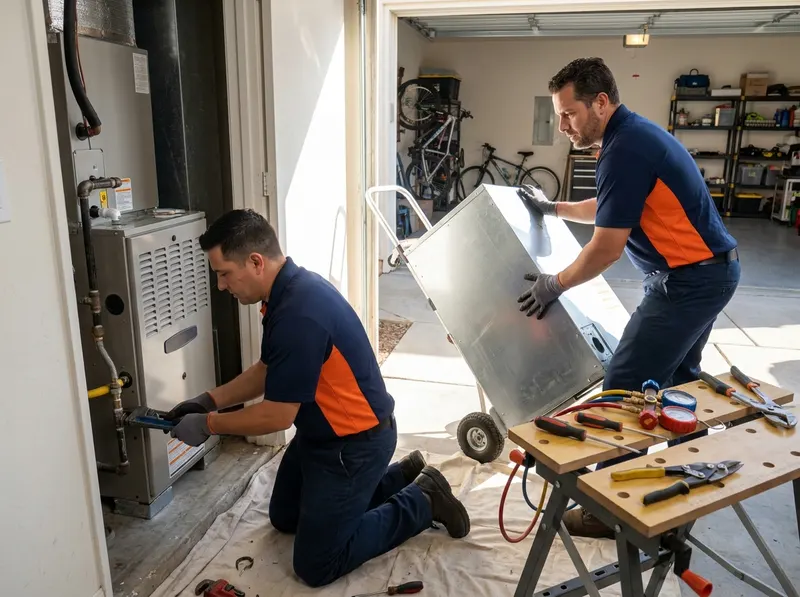
Replacing a furnace is a sizing decision first and a brand decision second. Many Irvine homes still run the original furnace the builder installed, and in mild Orange County winters an oversized unit short-cycles, kicking on and off, heating unevenly, and wearing itself out faster. During the free visit we measure the space, check ductwork, and match the furnace to what the home actually needs rather than defaulting to the largest option. That matters as much in a compact University Park townhome as it does in a larger Turtle Rock or Quail Hill single-family house with a two-story duct run.
Furnace replacement makes sense over repair when the unit is roughly 15 years or older, the heat exchanger is cracked, parts are hard to source, or repair costs are climbing toward half the price of a new system. If your furnace is younger and the failure is a single component like an igniter or blower motor, a repair is usually the better value, replacement is not automatically the answer. We say so on-site rather than pushing a new unit when the old one has good years left.
Access drives a lot of the cost in Irvine. Attic-mounted furnaces common in Northwood, Woodbridge, and Portola Springs homes take longer to swap than a garage or closet unit in Oak Creek or Cypress Village. Newer construction in Great Park Neighborhoods and Northpark often has cleaner, code-current setups that go quickly, while older Woodbridge installs sometimes need venting or gas-line updates to meet current standards. We flag any of that before we start, not after.
Efficiency choice is straightforward here: a standard 80% AFUE gas furnace costs less up front, while a 90%+ condensing furnace or a heat-pump alternative costs more but uses less energy over time. Given Irvine's short heating season, we walk through the trade-off honestly instead of assuming the highest-efficiency unit is right for every household. The exact price depends on the unit and your home, confirmed in the written on-site quote.
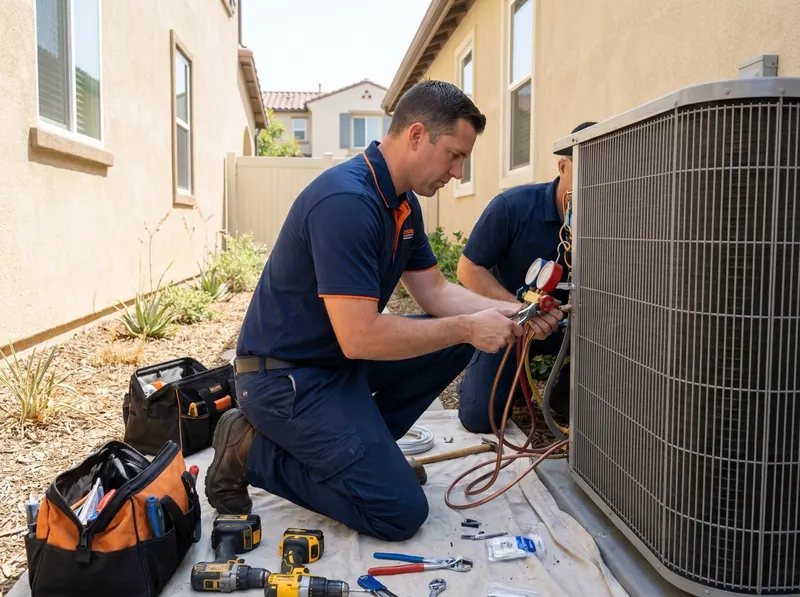
A heat pump makes the most sense in Irvine when you already need to replace an aging AC and want heating in the same project, or when you are moving off gas in newer all-electric homes common across Cypress Village, Portola Springs, and the Great Park Neighborhoods. Because these developments are built tight with modern insulation and often pre-wired for electric systems, the switch is usually straightforward and pairs well with existing ductwork. Older tracts in Woodbridge and University Park sometimes need an electrical panel check first, since a heat pump air handler and outdoor unit draw differently than a gas furnace paired with AC.
The main trade-off versus a traditional gas furnace plus AC is upfront cost against long-term operating cost. A heat pump usually costs more to install because it replaces two systems with one integrated unit, but it runs on a single electric supply and delivers efficient heating during Irvine's cool, damp winter nights near Turtle Rock and Bommer Canyon. If your gas furnace is still healthy and only the AC has failed, a straight AC replacement may cost less today. If both are near end of life, a heat pump consolidates the work into one install and one system to maintain.
Proper sizing matters more than brand. A two-story home in Northwood with west-facing glass has a different cooling load than a single-story Quail Hill plan shaded by hillside, and an oversized heat pump short-cycles while an undersized one struggles on the warmest Irvine Spectrum afternoons. Every installation starts with a load calculation rather than a guess based on square footage alone. We also confirm refrigerant line length and condensate drainage, which vary in attic-mounted air handlers found in many Northpark and Oak Creek homes.
Heat pump projects in Irvine require a permit and inspection through Orange County processes, and we pull that as part of the job. Newer neighborhoods often have HOA guidelines on outdoor unit placement and screening, so we place the condenser where it meets both airflow needs and community rules. The free on-site visit is where we measure, check your electrical capacity, and give you an exact number instead of a phone estimate.
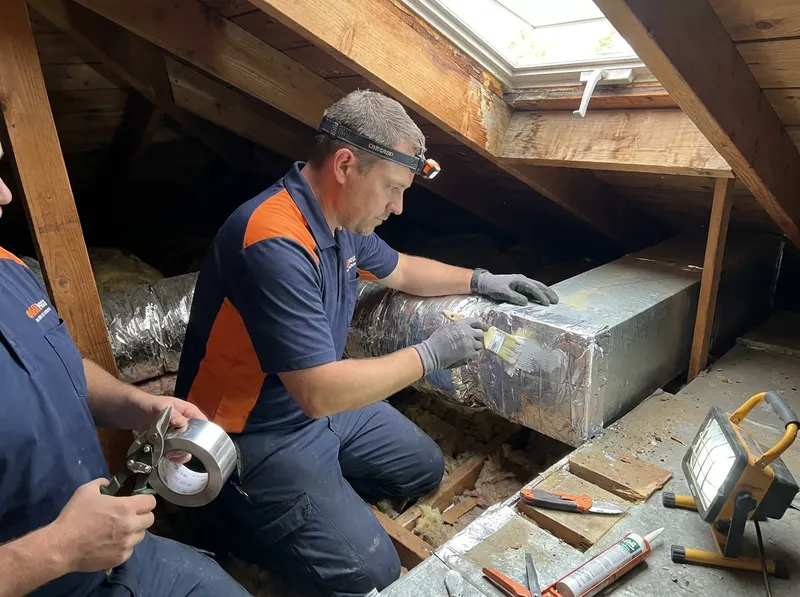
Duct problems in Irvine often trace back to the attic. Many homes across Woodbridge, University Park, and Northwood run their supply and return ducts through hot attic space, where flex duct can crush, sag, or pull loose at the connections over the years. When a joint separates, cooled air dumps into the attic and the room it was meant to serve never gets comfortable. Sealing those joints and re-securing the runs is usually the difference between an air handler that cycles constantly and one that keeps the whole house even.
Ductwork repair fits best when the equipment itself is healthy but comfort is uneven or utility costs have crept up without an obvious cause. If one bedroom in a Quail Hill or Portola Springs home never cools while the living area is fine, a duct leak or a collapsed section is a likely culprit. Sealing is the smaller, targeted fix; full duct replacement is the alternative when the system is old, mold-affected, or badly undersized. The trade-off is straightforward, sealing costs less and preserves existing runs, but if the ductwork is deteriorated throughout, repeated patching becomes false economy and replacement is the better long-term value.
Irvine's climate makes tight ducts worth the effort. Summer attic temperatures near the Great Park Neighborhoods and Cypress Village can climb well past what the living space sees, so every gap in a supply run is losing already-cooled air into the hottest part of the house. Newer construction in Northpark and Oak Creek generally has cleaner duct layouts, while older Turtle Rock and Woodbridge homes are more likely to have aged flex duct and taped joints that have dried out and let go.
Every repair ends with a check that airflow actually improved at the registers, not just at the sealed joint. A free on-site visit is how the scope and honest price get set, because the amount of accessible ductwork and the number of failed connections vary house to house across Orange County.
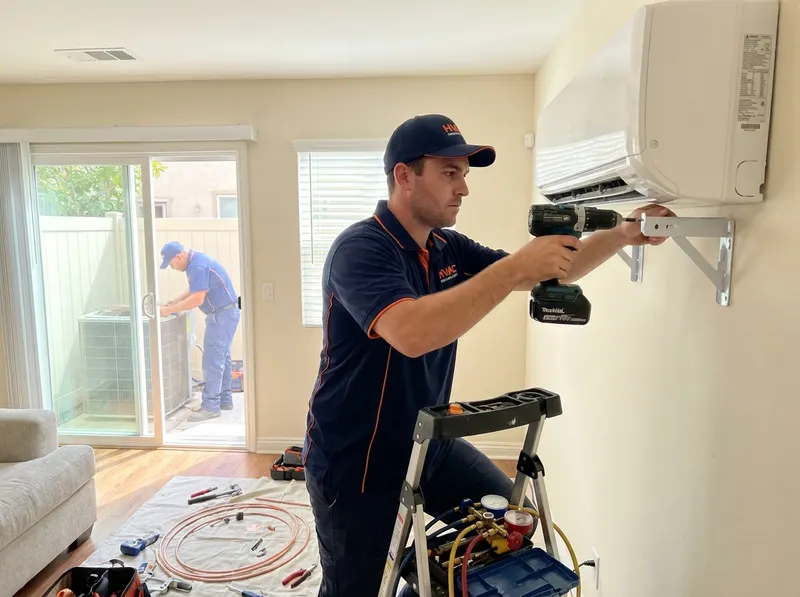
A mini-split is the right call when adding ductwork is impractical or wasteful. Many Irvine homes in Northwood and Turtle Rock have finished bonus rooms, converted garages, or upstairs offices that stay uncomfortable because the central system was never sized for them. Running new ducts to one problem room often means opening walls and losing conditioned air to leakage. A ductless head serves that single space directly, and because each zone runs independently you only cool or heat the rooms in use. For newer Great Park Neighborhoods and Cypress Village ADUs and detached studios, a mini-split is frequently the only heating and cooling that makes sense, since the accessory unit has no shared duct trunk.
The trade-off worth knowing: a mini-split puts a visible indoor unit on the wall or ceiling and needs one outdoor condenser location. If a home already has healthy ducts and a working furnace, replacing a central system usually costs less per conditioned square foot than adding several mini-split zones. The decision comes down to layout. One or two stubborn rooms favor ductless; whole-home comfort in a home with sound ducts usually favors a central system. During the on-site visit in areas like Quail Hill, Portola Springs, or Oak Creek, we measure the room, check the electrical panel capacity, and confirm the shortest clean line-set path before quoting.
Proper sizing matters more than brand. An oversized head short-cycles and leaves humidity high; an undersized one runs constantly on hot Orange County afternoons. We calculate the load for the actual room rather than guessing by square footage, which is why placement in a west-facing Northpark room with afternoon sun differs from a shaded interior University Park bedroom. Installation quality also drives long-term performance: a mini-split must be vacuumed to remove moisture from the lines before the refrigerant charge, and mounting the condenser on a stable pad or bracket keeps vibration and noise down near patios and side yards typical of Woodbridge lots.
Multi-zone systems connect several indoor heads to one outdoor unit, which suits homes wanting to cover a primary suite, an office, and a living area without a full ducted retrofit. Each head has its own remote and setpoint, so household members control their own rooms. We confirm the number of zones, the mounting style, and the outdoor unit location at the free assessment so the written estimate reflects the real job.
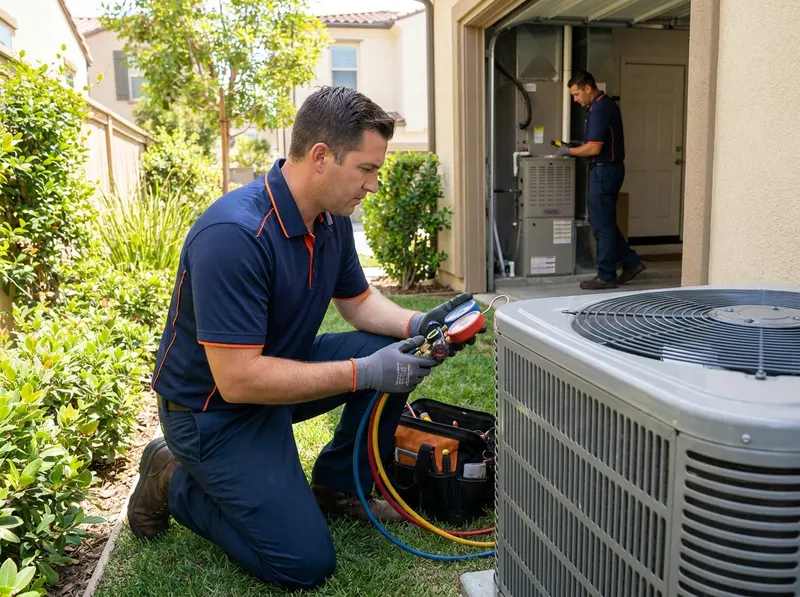
The best time to tune up matters more in Irvine than people expect. Cooling systems in Turtle Rock and Quail Hill work hardest during the dry inland afternoons of late summer, so a spring AC tune-up before that stretch catches a weak capacitor or low refrigerant charge while it is still cheap to address. Heating gets less use here than in colder climates, but Irvine's cool, damp winter nights still push furnaces and heat pumps in Woodbridge and University Park, and a fall check on the heat exchanger and ignition is a genuine safety item, not a formality.
A tune-up is the right call when your system runs but you want to hold onto efficiency and avoid a mid-heatwave breakdown. It is not the right call when something is already broken or clearly failing; a system short-cycling, tripping breakers, or blowing warm air needs a repair diagnosis instead, and paying tune-up rates to find that out wastes money. The trade-off is straightforward: maintenance is a modest, predictable cost that reduces the odds of a large surprise one, but it cannot rescue a compressor that is already on its way out. For newer homes in Portola Springs, Cypress Village, and the Great Park Neighborhoods, annual maintenance also helps keep manufacturer warranty terms intact, since many require documented service.
Irvine's local conditions shape what a tune-up actually finds. Fine dust drifting off open land near Bommer Canyon and the edges of the Great Park loads up filters and outdoor condenser coils faster than a sealed suburban block would suggest, and clogged coils are one of the most common efficiency killers we see in Oak Creek and Northwood. Homes near the San Joaquin Wildlife Sanctuary and the marshy stretches around William R. Mason Regional Park see more humidity, which makes condensate drain clearing worth doing every visit to prevent backups and overflow.
Many Irvine households pair a spring and fall visit under a maintenance schedule. That cadence spreads the cost, keeps both sides of the system tuned to the season, and gives you one contractor who already knows your equipment when a real issue does surface. If you are unsure whether your system needs a tune-up or a repair, describe the symptom when you call and we will point you to the right visit rather than the more expensive one.
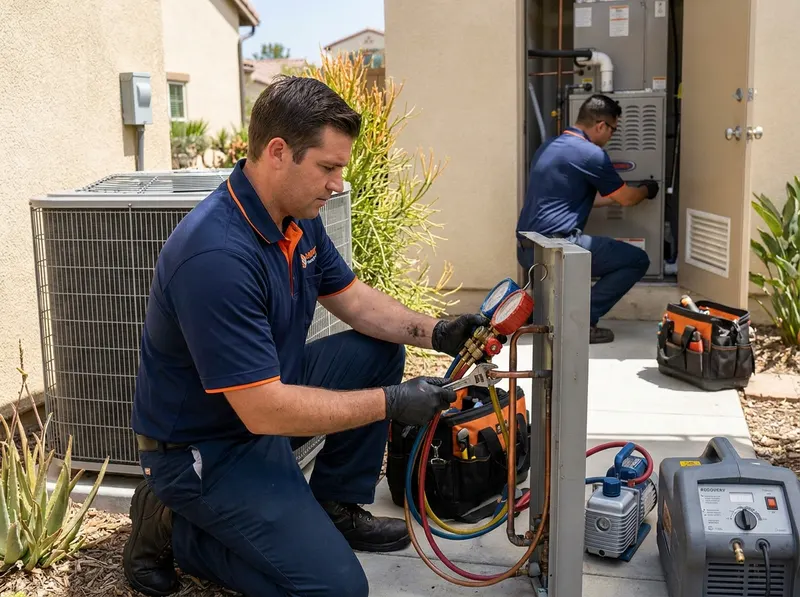
Emergency service makes sense when the failure is affecting comfort or safety right now and cannot wait a day or two. A home in Quail Hill or Turtle Rock that loses cooling during an afternoon in the high 90s, or a Northwood house with no heat overnight, is a genuine emergency. If a system is still running but noisy, cycling oddly, or only slightly underperforming, a scheduled repair visit is usually the better value, because the diagnostic time is the same and the urgency premium is avoided. The trade-off is straightforward: emergency service buys speed, and a planned appointment often buys a lower total.
Irvine's building mix shapes what tends to fail. Older Woodbridge and University Park homes often run aging condensers and furnaces where capacitors, contactors, and blower motors give out first. Newer construction in Cypress Village, Portola Springs, and the Great Park Neighborhoods leans on high-efficiency and heat-pump equipment with control boards and sensors that can fault and lock the system out. Attic-mounted air handlers common across Oak Creek and Northpark also mean a clogged condensate line can trip a safety switch and stop cooling entirely, which reads as a full breakdown but is often a fast fix.
On an emergency call we lead with diagnosis so you know what actually failed before anything is replaced. Common on-site repairs include capacitor and contactor replacement, clearing a blocked condensate drain, resetting or replacing a tripped safety component, and swapping a failed blower or fan motor when the part is stocked. When a compressor or a special-order board is involved, we stabilize what we can, give you the honest picture, and schedule the follow-up rather than guessing.
Every emergency visit carries a $150 minimum, and specific repair pricing is a ballpark until the exact fault is confirmed at your home. Irvine's summer heat off the inland valleys near the Great Park and Bommer Canyon pushes cooling systems hard, so a quick honest diagnosis usually saves more than a delayed one. Call and describe the symptom clearly, and the visit gets routed and stocked accordingly.
If your air conditioner is under 10 years old and the failure is a single part like a capacitor, contactor, or fan motor, choose a repair, it is the lowest-cost path and often done same-day. If the system is 12 to 15 years old, uses R-22 refrigerant, and has failed more than once in a season, choose a replacement, because repair dollars stop returning value and R-22 recharges keep climbing. If you want the lowest install cost and already have gas service, a high-efficiency furnace paired with a straight-cool AC fits most Irvine tract homes; if you want the lowest monthly bill and qualify for utility rebates, a heat pump fits Irvine's mild coastal climate especially well since it heats and cools from one electric system.
The trade-off is upfront cost versus long-term operating cost: a repair or a gas furnace saves you today, while a heat pump costs more to install but runs cheaper year-round in Irvine's moderate winters. For homes in newer Great Park Neighborhoods or Cypress Village, ductwork is usually sound and a straight equipment swap is enough; for older Woodbridge or University Park houses, a duct inspection often matters more than the box itself. Sizing is the other fork in the road: if your last unit short-cycled and never quite dried the air out, the old equipment was likely oversized, and a correct load calculation matters more than buying a bigger box.
If you run a single-story Oak Creek or Northpark home with one return, a properly sized 3-to-4-ton system usually covers it; if you have a two-story Turtle Rock house with a hot upstairs, zoning or a duct correction fixes the comfort problem that a bigger condenser alone will not. Thermostat choice follows the same logic: if you want set-and-forget savings, a learning thermostat pairs well with a heat pump's steady output, while a basic programmable model is plenty for a gas furnace that only runs a few weeks a year here.
| On-site diagnostic / minimum service call | $150 (applied to repair) |
| AC repair (single part, capacitor, contactor, fan motor) | $150, $650 |
| Refrigerant leak search & recharge | $350, $1,200 |
| Compressor replacement | $1,500, $3,500 |
| Furnace repair (igniter, flame sensor, blower) | $150, $750 |
| Blower motor replacement | $450, $1,200 |
| Thermostat replacement / smart thermostat install | $175, $550 |
| Seasonal tune-up (AC or furnace) | $150, $275 |
| Duct sealing / minor duct repair | $400, $2,500 |
| Full duct replacement (typical home) | $3,500, $8,000 |
| Ductless mini-split (single-zone install) | $3,500, $6,500 |
| AC condenser + coil replacement (typical home) | $5,500, $11,000 |
| Furnace replacement | $4,500, $9,500 |
| Complete heat-pump system changeout | $9,000, $18,000 |
Call for a firm, all-in price before any work begins.
We give an upfront, written price before any work begins, you approve it first. No surprises.
Our work is done to standard and we stand behind it, a real fix, not a quick patch.
We’ll give you an honest assessment. If you don’t need the work, we’ll tell you.
Irvine's HVAC problems track its climate and its housing stock. The city runs mild and coastal near San Joaquin Wildlife Sanctuary and William R. Mason Regional Park, but inland pockets around Portola Springs, Bommer Canyon, and the Great Park Balloon bake under afternoon sun and dry Santa Ana winds, that combination cakes condenser coils with dust and pushes west-facing units hard from July through September.
The older Woodbridge, Turtle Rock, and University Park tracts, many built in the 1970s and 1980s, often still run original flex ductwork and aging systems, so a duct inspection frequently uncovers more savings than a new condenser would. Newer Cypress Village, Portola Springs, and Great Park Neighborhoods homes near the Irvine Spectrum Center are built tighter, hold conditioned air better, and pair well with high-efficiency heat pumps, but tight homes also make correct sizing and ventilation matter more, since an oversized unit in a sealed house short-cycles and leaves the air feeling clammy. Because winters here rarely dip below the low 40s, a heat pump carries the whole season easily, which is why so many California electrification and utility rebates lean toward them for Orange County homes.
Two-story houses across University Park and Northwood share a common complaint, a hot upstairs by late afternoon, which usually traces to duct restriction or a lack of zoning rather than an undersized system, and the fix is often cheaper than replacing the equipment. Homes near UC Irvine and the coastal edge stay milder year-round, while addresses closer to the foothills swing hotter in summer, so the same-size home can need a different system depending on which side of the city it sits on.